Connect and regret?
Why Ofgem must rethink DNO–installer relationships as part of electricity distribution price control for 2028 (ED3) to help increase low carbon technology adoption and avoid a phantom grid surge
November 25
To achieve net zero, around 24.5 million homes in the UK will need to install heat pumps (according to Energy Systems Catapult) and most will also require an EV charge point. With peak demand of 5-15 kW for heating and 7-11 kW for EV charging, this implies a potential peak electricity demand far beyond today’s system capability. In fact, Climate Change Committee’s Seventh Carbon Budget projects this conservatively at around 160GW. The scale-up required from today’s grid is significant, yet if installers are not incentivised to work with Distributed Network Operators (DNOs) and if DNOs remain unaware of a significant proportion of new low-carbon technology (LCT) installations, as current data suggests, the UK could encounter significant challenges ahead.
Beyond generation and network capacity, two systemic issues threaten to derail this transition if not addressed immediately:
- Inconsistent DNO application handling: despite substantial investment, the Energy Network Association’s (ENA) Connect Direct initiative (a platform designed to simplify applications to DNOs) has not yet achieved the harmonisation promised; each DNO handles LCT applications differently resulting in varying processes and turnaround times
- Insufficient installer support and incentives: installers often lack the support and incentives to complete applications accurately or at all, often competing with businesses that bypass processes altogether leaving consumers ultimately worse off
The current consultation on ED3, Ofgem’s next electricity distribution price-control regime for 2028–2033 which includes how DNOs will be regulated, presents a significant opportunity to address these issues.
The solution is simple: create one national, standard process for all DNOs to handle applications in the same way. Funding through ED3 should be linked directly to clear performance targets (SLAs) against this framework so that DNOs are rewarded for faster and more consistent service. To help make this a reality, Renbee are already working with a number of DNOs to start defining what this framework and underlying asset data structure should look like.
Ofgem should also review how the ENA and its Connect Direct platform are managed, to make sure they deliver value and are held accountable for process optimisation. Finally, existing schemes such as the boiler upgrade scheme grant and MCS certification should be used to ensure compliance and improve installer training and engagement.
The DNO bottleneck and the amplification from Connect Direct
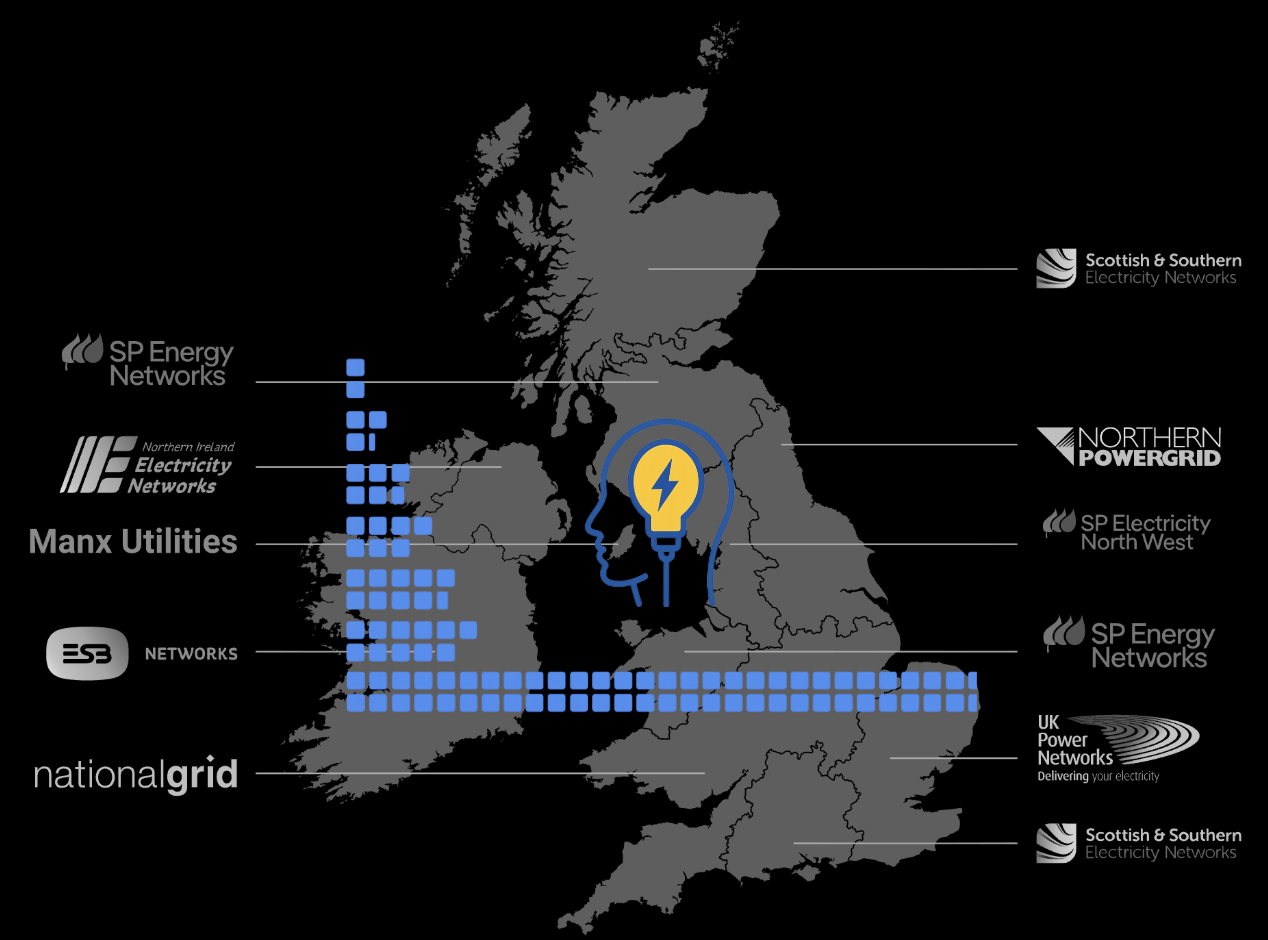
Data from the Renbee-chaired monthly roundtable with MCS (UK’s standards body for microgeneration) and four leading DNOs (UKPN, SSEN, National Grid, and SP Energy Networks), highlights major inefficiencies.
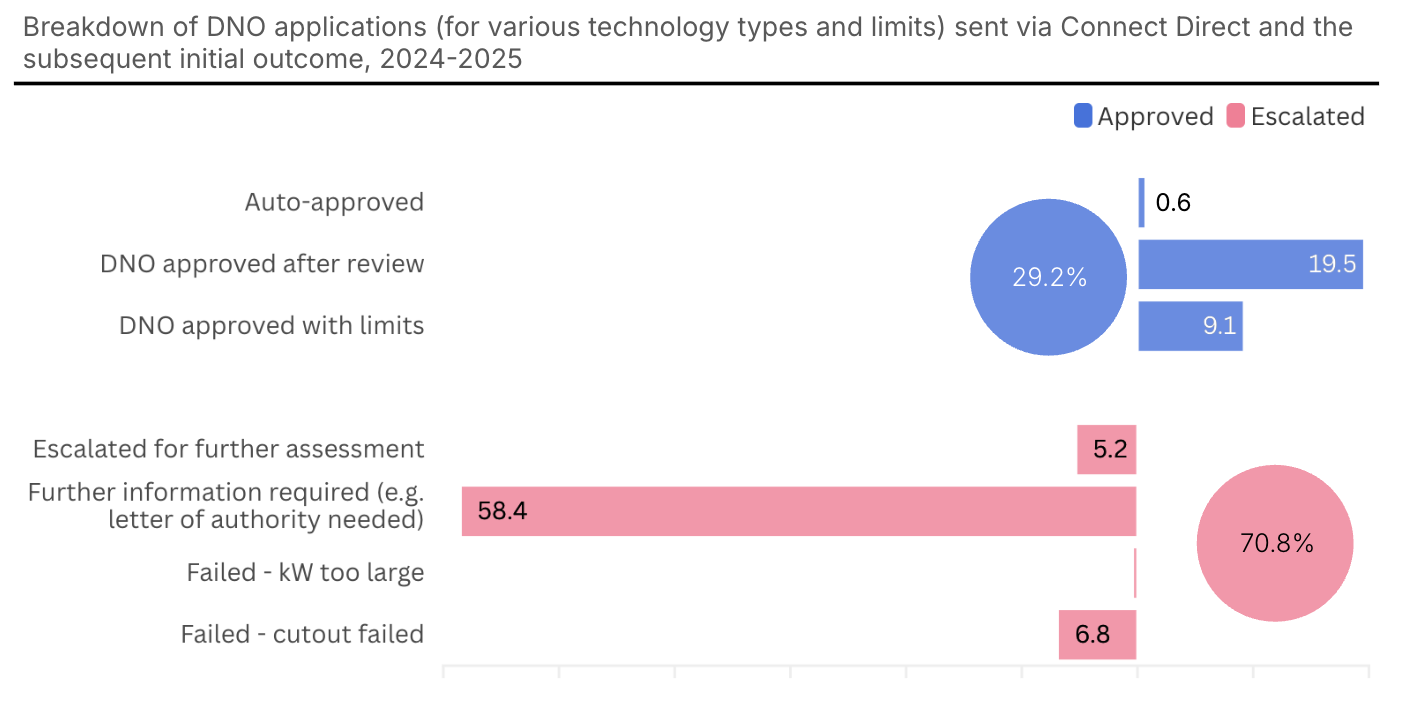
Over 60% of applications submitted via Connect Direct are escalated for manual review, while only 0.6% are automatically approved (source: Renbee platform sample data over a 12-month period). Reasons for escalation range from incomplete information to requirements for manual image review, site assessments, or network reinforcement.
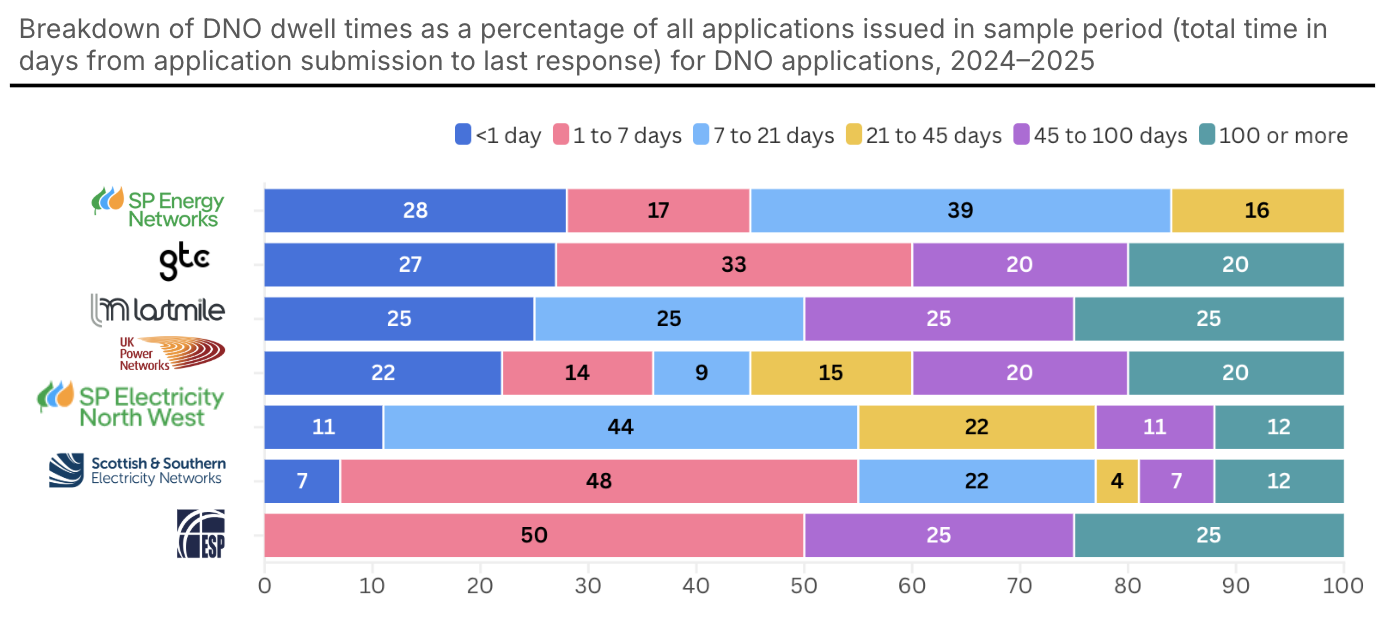
Response times also vary significantly from 2 days (UKPN) to over 50 days (Last Mile) with some “fast-track” processes taking as long as full applications elsewhere (formally identified as G99 applications). Installers routinely face delays exceeding 100 days, causing customer frustration and project backlogs.
The result is a patchwork of regional processes, unclear rules, and administrative churn that undermines compliance and innovation. Many installers, under commercial pressure, use workarounds such as undersizing systems, skipping applications, or estimating technical data - not necessarily out of neglect, but to keep projects moving. These behaviours underpin a need for education, clear guidance, and proportionate incentives, not simply enforcement.

Connect Direct: a good idea, poorly executed:
The ENA’s Connect Direct platform was intended to simplify and harmonise grid-connection processes through a single national portal. In practice, however, it has largely become an extension of the basic G98 process (typically for systems <3.68 kW per phase) and offers limited additional value for more complex applications.
Tools such as the “AI-enabled cut-out reader” often add time and cost without delivering meaningful benefits. Despite significant investment by the ENA, the tool fails to read cut-out ratings, and fails applications especially when the cut-out is partially obscured, located in tight spaces (garages, under-stairs cupboards), or poorly lit. This leads to installers having to revisit the site for new photos, ask customers to submit their own images, or attempt to progress the application using cut-out images from other properties.
Although all communication with the DNO could theoretically occur within Connect Direct’s comments feature, this functionality is barely used. Most applications are quickly escalated off-platform, creating fragmented workflows and unnecessary delay, particularly where upgrades or local reinforcement is required. This can be seen in the analysis below for certain DNOs across a sample of applications.
With heat pump installations rising 39% year-on-year from 2024 and over 120,000 MCS-certified solar PV systems completed in the first half of 2025 (up 36% from 2024), DNO administrative capacity is not keeping pace. Without operational reform, the gap between installations and processing capacity will only grow.
Installer confusion and compliance challenges:
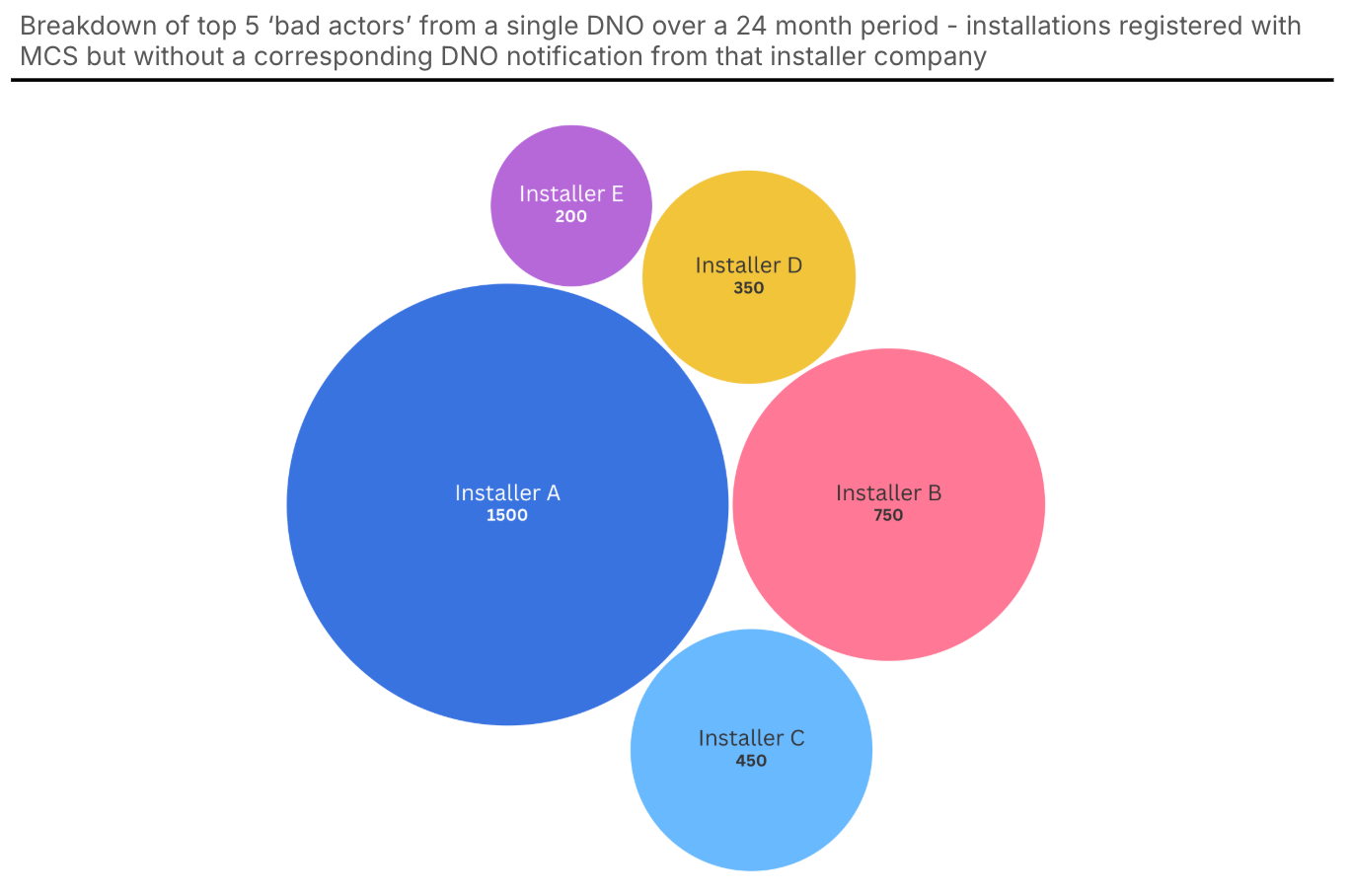
Renbee's work with hundreds of installers across the UK, supported by DNO roundtable insights, shows that compliance rates may be as low as 50%, if not more. Some installers are completing thousands of installations without notifying the relevant DNO; others apply creative “hacks” to make the process workable.
“We’ll apply for 3.68kW even though we’re installing 5kW — the customer wants maximum export.” Installer A
“We just use the cut-out rating as max demand — it always goes through.” Installer B
These comments reflect the confusion and procedural fatigue faced by installers, more than malice. They are being asked for new data points, such as estimated maximum demand post-installation or the cut out rating, without sufficient guidance or training to work this out. This inconsistency fuels errors and undermines trust in the process.
The way forward: Ofgem’s ED3 must drive change
With the upcoming ED3 price control period, Ofgem has a critical opportunity to reset how DNOs engage with installers and customers.
A clear path forward includes:
- A standardised national framework – all DNOs and IDNOs should use consistent processes, forms, and data standards. The system must also accommodate accelerated “distressed purchase” routes (when boilers break down and need immediate replacement). While network risk must still align with each DNO’s design authority, the customer and installer journey should be standard nationwide.
- Performance-linked SLAs within ED3 – KPIs should include LCT turnaround targets and transparency metrics to drive accountability and continual improvement. This will require better visibility of approval thresholds, G5 limits, voltage rise assessments, harmonics and supply assessment frameworks.
- Improved asset and supply data – initiatives such as UKPN’s Smart Connect portal and SSEN’s supply visibility pilots (looped vs unlooped services, cut-out ratings, etc.) show how high-quality data enables faster DNO decision-making. These lessons should be scaled nationally with appropriate funding. Greater data sharing, including smart meter and GIS data, would enable better forecasting, reduce unnecessary escalations and accelerate approvals.
- Reassessing Connect Direct ownership – if Connect Direct remains the standardisation tool, Ofgem should evaluate whether a trade association that represents DNOs is the right body to oversee it. Independent oversight would ensure that the platform evolves to deliver value, not bureaucracy. Any future development should include operational experts who understand installer and DNO challenges.
- Installer incentives and education – link BUS grants and MCS certification to successful DNO applications. This simple step would improve compliance and data accuracy. More importantly, installers need better guidance on why the process matters - for grid safety, customer protection and system stability.
Conclusion: from friction to flow
Achieving net zero demands more than new generation capacity - it requires a smarter, fairer and more consistent connection process. DNOs, installers and regulators must operate as partners, not adversaries. Without decisive action in ED3, the UK risks administrative gridlock, frustrated homeowners and stalled progress in the low-carbon transition.
Renbee, alongside UKPN, SSEN, National Grid, SP Energy Networks, IAA and MCS, will continue to drive practical collaboration through our monthly roundtable discussions.
If you are a DNO or IDNO ready to shape the future of connections, join us. If you are an installer seeking clarity and support with DNO applications, we are here to help.
Together, we can build a faster, fairer and smarter path to net zero.
